
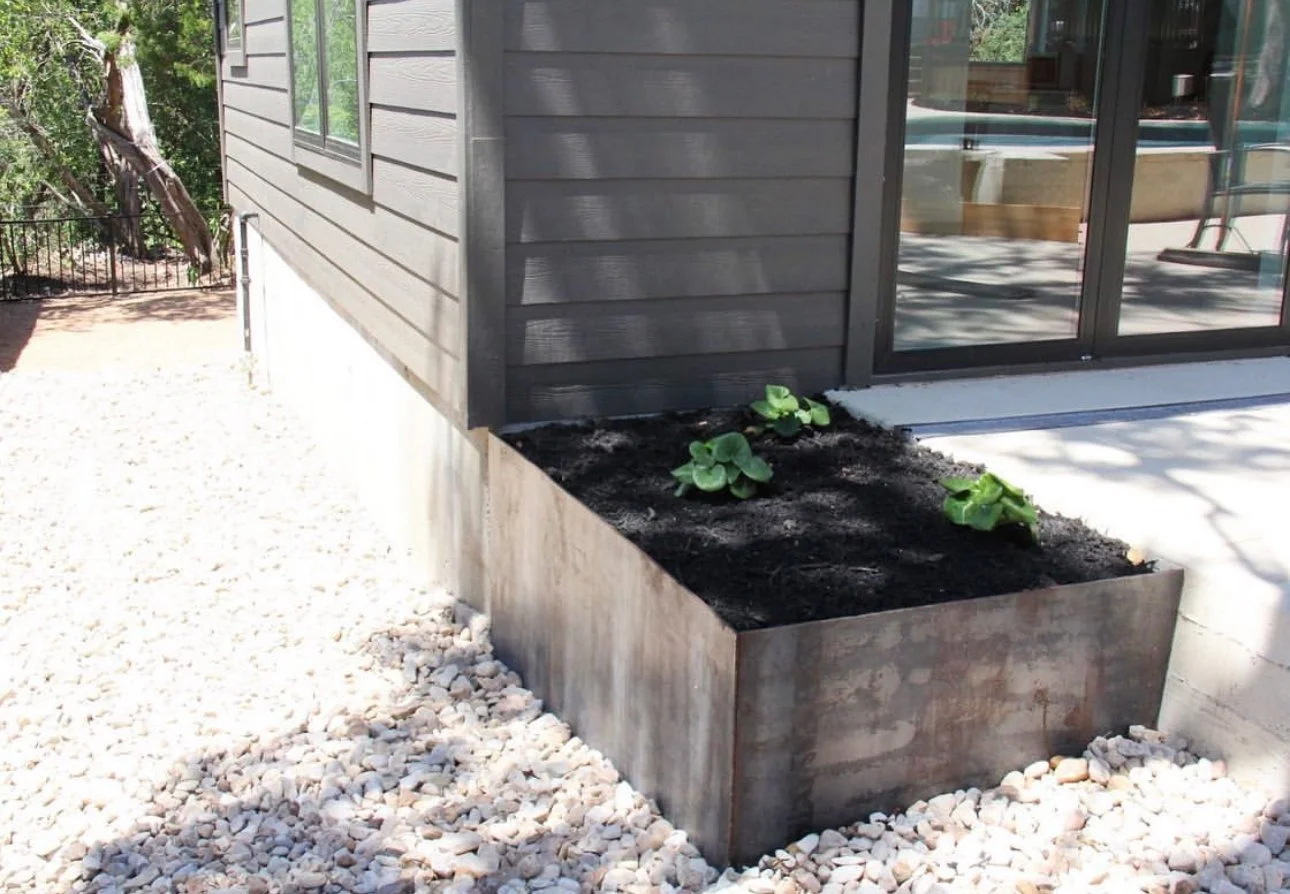
Custom Welded Steel Planters, Built in Our Own Shop in Cedar Park
Most Austin companies order your planter from a catalog. We cut, weld, and finish ours ourselves, which is why we can build to your dimension instead of the nearest stock size. Corten weathering steel planters designed for your space, welded in house, and installed with the drainage, leveling, and irrigation tie in that decides whether a planter looks right in year five.
Welded In House • Built to Your Dimension • Licensed and Insured • Free Estimates • You Pay in Full Only When Satisfied
The Short Version
You get a planter welded to your dimensions in our own shop, not a stock box with a delivery date. We design it into the yard rather than setting it on top of one, which means drainage that protects your patio, a base that stays level on Central Texas ground, drip irrigation run before the soil goes in, and a soil mix built for what you actually want to grow instead of what our alkaline ground will allow. Prices are published below. Estimates are free. Final payment waits until the finished work meets your complete satisfaction.
What Nobody Tells You Before You Buy a Steel Planter in Central Texas
Corten is a genuinely great material for this climate. It is also the material we get called about most often after somebody else installed it. Three problems account for nearly all of it, and all three are solvable at the design stage rather than after.
Problem one: the first rain will stain your patio, unless the planter was built to prevent it.
Weathering steel forms its protective patina through repeated wet and dry cycles, and during that early weathering period it sheds rust colored runoff. On decomposed granite nobody notices. On a new limestone patio, a light concrete pool deck, or a poured walkway, that runoff leaves streaks that are a genuine problem to remove.
This is design, not luck. We pre weather planters in the shop before they ever reach your patio, so the heaviest shedding happens on our floor instead of your stone. We build in drip gaps and set planters on standoffs so runoff drops clear of the hardscape rather than sheeting down onto it. Where a planter sits directly against light colored stone, we detail a gravel or steel drip zone at the base. Ask any competitor how they handle the first ninety days of runoff. Most have never thought about it.
Problem two: steel in Austin sun gets hot, and roots feel it.
Metal raised beds measured in full sun run soil temperatures in the mid 90s to around 100 degrees Fahrenheit at 6 inches deep by late afternoon, and most vegetables take real heat stress above 95. Austin delivers 100 plus days a year over 95 degrees. A shallow, narrow, dark planter on a west facing wall is a solar oven with dirt in it.
So we design around it. Depth is the cheapest fix, because a deeper soil column holds a cooler core, and we spec a minimum of [X] inches for anything you intend to grow food or perennials in. Width matters for the same reason. On west and southwest exposures we can add rigid insulation board to the sun facing wall before backfill, which is a shop step, not a retrofit. We run drip before the soil goes in so the planter is watered at the root zone rather than the surface, and we mulch heavily. And when a location is simply too hot for what you want to plant, we will tell you that during the estimate rather than after your first August.
Problem three: our ground is the reason you want a planter in the first place.
Texas A&M AgriLife’s Travis County office describes local soils plainly. They are alkaline, high in phosphorus and potassium, short on organic matter, and poorly suited to acid loving plants. West of I-35, out through Cedar Park, Leander, Lakeway, and the Hill Country, you are gardening in a thin layer of dirt over limestone and calcareous rubble. East of I-35 you are in Blackland clay that swells and shrinks with every wet and dry season.
You cannot fix that ground. You can build on top of it. A welded steel planter is the most direct way to import the root zone you actually want, at the depth you want, exactly where you want it, without excavating rock. That is why we build them, and it is why we treat the soil mix and the drainage as part of the job rather than something you sort out later.
Planters We Fabricate
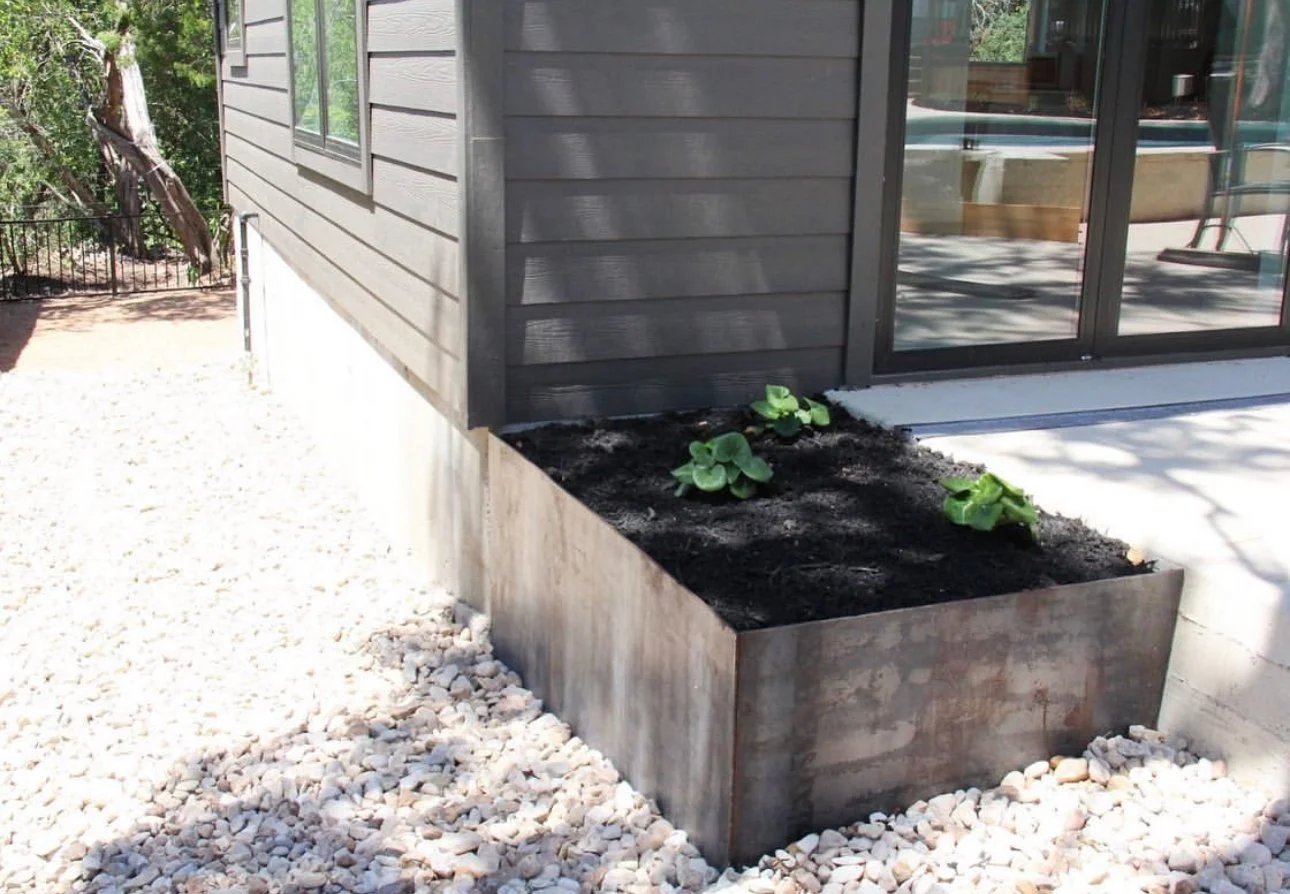
Raised garden and kitchen beds. Food growing depth, drip ready, and sized to the reach you actually want across the bed. Corten is safe for edibles. The iron oxide that forms as it weathers is non toxic, and the trace copper, chromium, manganese, and nickel in the alloy occur at levels plants use as micronutrients rather than accumulate as contaminants.
Architectural planters and privacy screens. Tall planters that do a wall’s job without a wall’s permit conversation. Common on modern Austin builds where a low steel mass reads better than block.
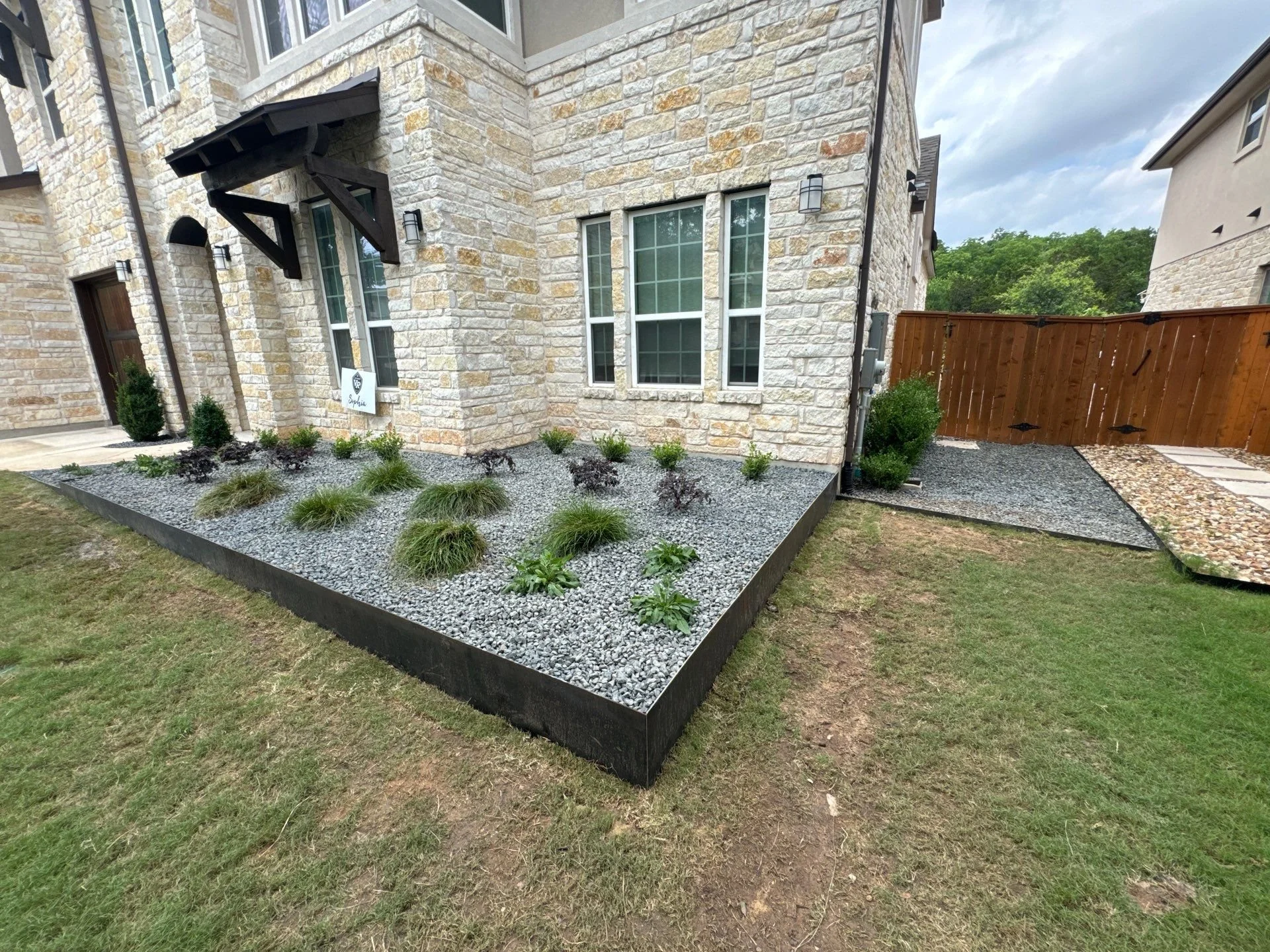
Terraced and stepped planters for slopes. Instead of one tall retaining wall, a run of stepped planters that holds grade, plants at multiple levels, and costs less than engineered wall work in many cases. On sloped Hill Country lots this is often the better answer, and we will say so even though it is the smaller ticket.
Tree and specimen planters. Larger volumes for multi trunk natives, olives, and specimen plantings, with root volume and drainage sized to the plant rather than to a catalog page.
Bench, seat, and edge integration. Planters welded to double as seating edges, entry markers, or the transition between patio and bed.
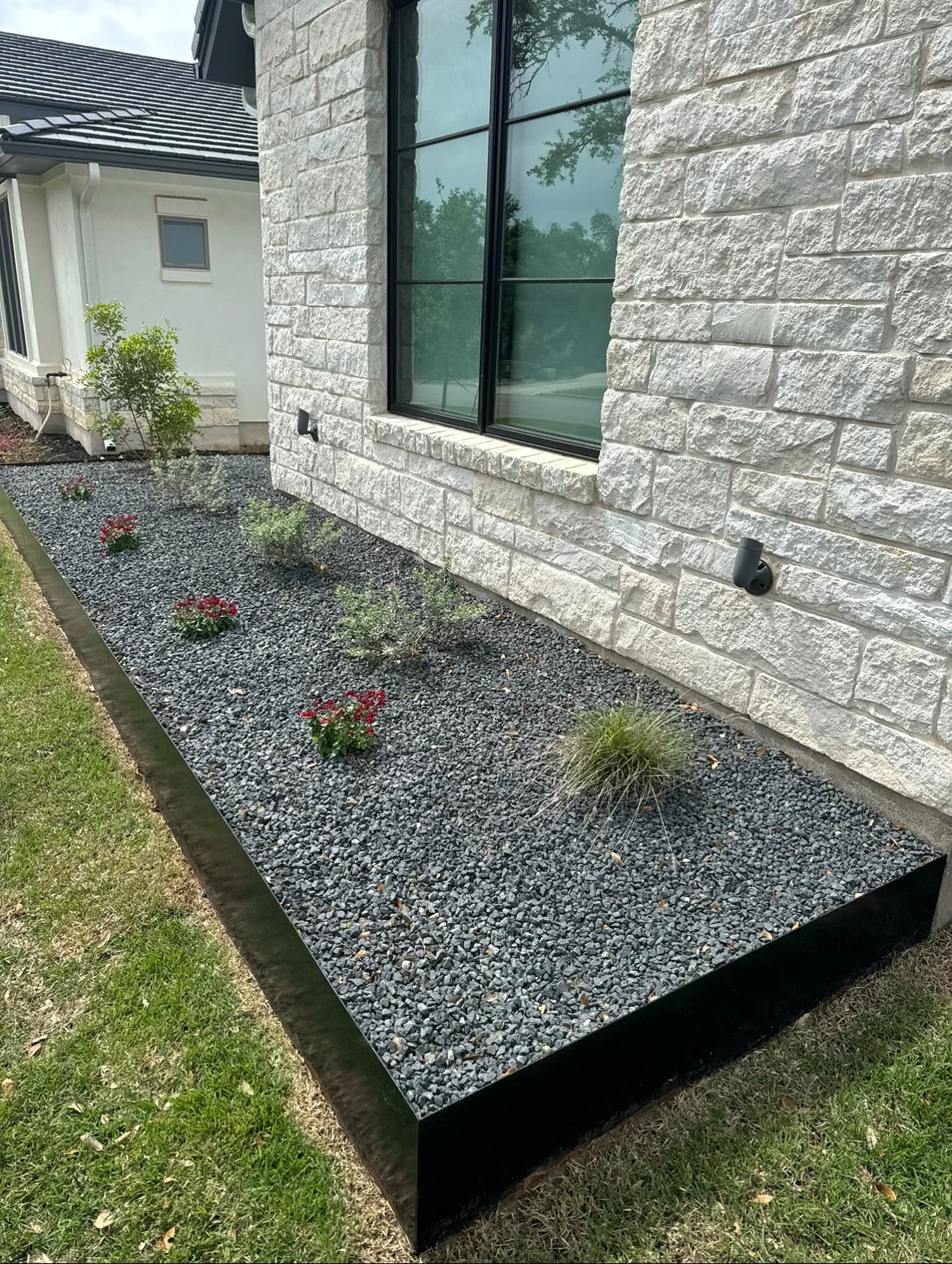
Steel edging. Clean lines between bed and lawn or gravel, in matching weathering steel, cut and set on site rather than trimmed from a stock strip.
Our Build Spec
Steel planters fail in boring, predictable ways: thin panels that oil can and bow under wet soil, seams that open, no drainage, and a base that settles crooked. Here is what we do instead.
Material. [Confirm spec: gauge or plate thickness, e.g. 1/4 inch plate or [X] gauge A606 or A588 weathering steel.] Market context for setting this: the strongest spec published locally is 1/4 inch cold rolled plate with mid rib supports.
Seams. Continuous welded seams, ground and finished, not fastened corners. This is the difference an in house welder makes and it is worth photographing.
Structure. Internal bracing and rib supports on any span long enough to flex, because wet soil pushes harder than people expect. [Confirm bracing spec and the span at which it is added.]
Drainage. Every planter is built to drain, and drainage is placed so water leaves the planter without running across your hardscape. Interiors get [confirm: protective coating, drainage layer spec, and whether a liner is used].
Setting. Planters are set on a prepared, compacted base and leveled, not dropped on grade. On clay this is what keeps them from tilting through the first wet and dry cycle. On rock it is what keeps them from rocking.
Irrigation. Drip is run before soil goes in, tied into your existing system or a new zone. Retrofitting drip into a full planter is a bad afternoon that we would rather you never have.
Finish. Pre weathered in the shop, or delivered raw if you want to watch the patina develop, or powder coated in a color you choose. We will walk you through what each one looks like at month one, month six, and year five.
How a Planter Project Runs
1. Site visit and free estimate. We measure the space, check grade and drainage, look at sun exposure, and ask what you want to grow. Sun exposure changes the design, so we want to see it rather than guess.
2. Design and itemized estimate. Dimensions, steel spec, finish, drainage detail, drip plan, and soil mix, priced line by line. No allowances that grow later.
3. Fabrication in our shop. Cut, welded, braced, finished, and pre weathered if that is the finish you chose. Typical lead time 2 to 6 weeks.
4. Install. Base prep, set and level, drainage and drip connected, soil placed, planting if it is part of the scope. Most planter installs take 3-10 days on site.
5. Walkthrough on your terms. You do not pay in full until the finished work meets your complete satisfaction. [Confirm written warranty terms on welds and finish.]
The Shop Behind the Steel
Ben Bretz has owned and operated companies in the lawn and landscape industry since 1993. He and Dani run this family business today, and their son Josh runs the landscape division from the field rather than from behind a desk. Our founding principle is borrowed from The Go-Giver: offer more in value than you receive in payment.
Keeping fabrication in house is what that looks like on this service. When the person who welds your planter also grades the bed it sits in and runs the drip inside it, nothing gets blamed on a vendor. It also means we can tell you honestly when a steel planter is the wrong answer for your space, which is a conversation a company that only sells steel planters is not going to have with you.
We are licensed and insured, every estimate is free, and we do not collect full payment until the finished work meets your complete satisfaction.
Where We Build
Based in Cedar Park and serving the greater Austin metro and Hill Country, including Austin, Bee Cave, Cedar Park, Dripping Springs, Fredericksburg, Georgetown, Johnson City, Lakeway, Leander, Liberty Hill, Marble Falls, Spicewood, Steiner Ranch, West Lake Hills, and Wimberley.
Steel Planter Questions, Answered
How much do custom steel planters cost in Austin? Fabricated and installed planters generally run $5,000 to $20,000 depending on size, steel thickness, and how much site work the location needs. Stock boxes from a supplier start lower, around $600 for a 4 foot planter, but that price does not include base prep, leveling, drainage, drip, or soil. The pricing section above has our current ranges and estimates are free.
Will a Corten planter stain my patio? It can, if it was not built to prevent it. Weathering steel sheds rust colored runoff while its patina forms, and on light limestone or concrete that runoff leaves streaks. We pre weather planters in the shop, build in drip gaps, and set planters so runoff falls clear of hardscape. Ask anyone bidding your project how they handle this.
Are Corten steel planters safe for growing vegetables? Yes. The iron oxide that forms as weathering steel patinas is non toxic, and the copper, chromium, manganese, and nickel in the alloy are present at levels plants treat as micronutrients. We build kitchen beds in Corten regularly.
Does the soil get too hot in a steel planter during an Austin summer? It can in a shallow planter in full afternoon sun. Measured metal beds hit the mid 90s to around 100 degrees at 6 inches deep on hot afternoons, and most vegetables stress above 95. We design around it with depth, width, rigid insulation on sun facing walls where needed, drip at the root zone, and heavy mulch. On a west facing wall we will also tell you which plants will not be happy there regardless of the planter.
How long do welded steel planters last? Weathering steel used correctly is measured in decades rather than years, which is the whole reason it costs more than a timber bed up front. Lifespan comes down to steel thickness, weld quality, drainage, and whether the interior was protected.
How long does it take for the rust patina to develop? Raw weathering steel starts coloring within weeks and looks settled over the first several months, then continues to deepen. The patina needs alternating wet and dry cycles to form properly, which Central Texas provides naturally. If you want the finished look on day one, we pre weather in the shop.
Do steel planters need drainage or a liner? Drainage, always. A planter that holds water rots roots and shortens the steel’s life from the inside. Liners and interior coatings are a design choice we make based on what you are planting and how the planter is built. We will explain the tradeoff during your estimate rather than defaulting to whatever is cheapest.
Can you build a planter for an odd space, a slope, or a curve? That is the reason to hire a shop instead of ordering a box. We build to your dimension, including angled ends, curves, stepped runs on grade, and planters that tie into an existing patio edge or wall.
Do you build powder coated planters instead of Corten? Yes. Powder coating in the color you choose is available on any planter we build if the weathered look is not what you want.
When do I pay? A deposit schedule is set out in your estimate, and final payment is not due until the finished work meets your complete satisfaction.
Do you also design the rest of the landscape? Yes, and planters usually turn out better when they are planned with everything else. We design and install complete landscapes including hardscape, drainage, irrigation, and lighting.
Tell Us the Space and We Will Tell You What It Takes
Send dimensions, a photo, and what you want to grow. We respond with a free estimate, an honest read on sun and soil, and a real number before you commit to anything.
Get Your Free Planter Estimate: Call (512) 740-5831 or email bbretz@outsiderscl.com Monday to Friday, 8am to 5pm.
Ready to Love Your Yard?
If you are a Cedar Park or Austin homeowner ready to stop tolerating your outdoor space and start enjoying it, we would love to talk. All estimates are free, and we serve Cedar Park, Leander, Round Rock, Georgetown, Pflugerville, and the greater Austin area.